

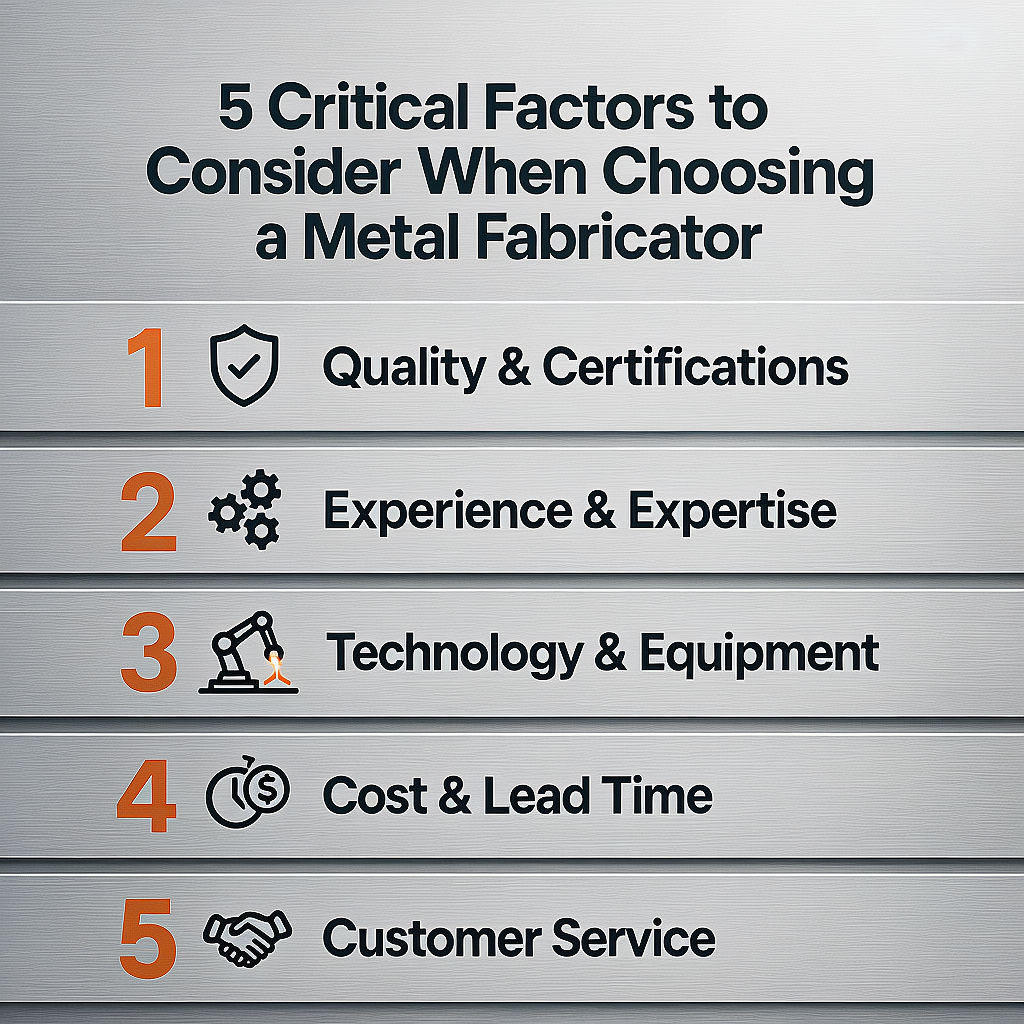
5 Critical Factors to Consider When Choosing a Metal Fabricator
Picking a metal fabricator feels overwhelming. Too many shops promise “precision work” and “fast turnaround.” Most deliver headaches instead. Wrong choice kills projects dead. Your bracket won’t fit. Deadlines slip. Budgets explode.
Good fabricators transform vague sketches into working prototypes. Bad ones generate scrap piles and excuses. These five factors separate shops worth your money from time-wasting operations.
1. Equipment Capability – Modern Machines Beat Manual Labor
Old fabricators brag about “40 years experience.” Forty-year-old brakes don’t bend modern steel cleanly. Equipment age reveals true capability faster than sales pitches.
CNC-controlled presses hit tolerances ±0.1 mm consistently. Manual operators drift ±0.5 mm between parts. Your assembly gaps appear mysteriously.
Fiber lasers cut 25 mm steel cleanly versus CO2 lasers leaving heat-affected zones. Clean edges reduce secondary finishing by 70%.
Modern 5-axis waterjets handle titanium composites without heat distortion. Plasma cutters sacrifice precision for speed—±1 mm slop typical.
Tube benders with mandrel support maintain roundness through 180° bends. Simple benders collapse tubes into D-shapes ruining hydraulic lines.
Walk their shop floor unannounced. Count CNC machines versus manual relics. Spotless Amada or Trumpf presses signal serious operations. Rusty 80s Di-Acro brakes scream “hobby shop.”
Ask specific questions:
- “What thickness aluminum can your fiber laser pierce cleanly?”
- “Show me round tube bends from yesterday.”
- “What’s your smallest punch diameter on 12 gauge steel?”
Vague answers mean guesswork. Precise measurements prove competence.
Red flags: Dusty machines. Missing safety guards. Oil-soaked floors. No CAD/CAM stations near machines.
Quality fabricators invest 20% annual revenue in equipment upgrades. Their machines justify premium pricing through zero rework and on-time delivery.
2. Material Knowledge – Not All Steel Cuts Equal
“Steel is steel” mentality destroys projects. Fabricators treating 304 stainless like mild steel generate scrap bills.
Cold-rolled 1018 machines buttery smooth at 200 IPM feeds. 4140 pre-hard laughs at carbide tools chewing inserts every 10 minutes. Wrong speeds ruin tooling budgets.
6061-T6 aluminum work-hardens if you dwell during milling. 5052-H32 bends beautifully at 1T radius. Wrong alloy choice cracks your enclosures.
Galvannealed steel powder coats perfectly. Hot-rolled pickled/oiled rejects coatings creating fisheyes. Surface prep ignorance costs refinishing fees.
Experienced fabricators ask probing questions:
- “What’s your operating environment—indoor/outdoor/marine?”
- “Will parts see welding, machining, or forming?”
- “Any plating or powder coating requirements?”
Inventory depth reveals seriousness. Shops stocking 316L marine-grade, AR500 wear plate, 90/10 cupro-nickel handle real projects. One-trick mild steel shops serve hobbyists.
Thickness availability matters. 26 gauge tray flanges bend differently than 16 gauge brackets. Shops maintaining 22 gauge to 1/2″ plate inventory avoid mill order delays.
Certifications confirm knowledge. ISO 9001 proves documented material processes. AS9100 aerospace certification demands material traceability. AWS D1.1 welding qualification shows structural steel competence.
Test them: “Can you source Inconel 625 sheet under 1 week?” Weak supply chains mean excuses later.
3. Quality Control Systems – Inspection Beats Finger-Gauging
“Fits good enough” destroys assemblies. Real fabricators measure every critical dimension before shipping.
Coordinate Measuring Machines (CMM) verify hole patterns to ±0.001″. Calipers drift ±0.005″ between operators. Your bolt circle errors cause field failures.
Keyence laser scanners capture complex surfaces instantly. Manual templates lie about compound bends. FARO arms verify large weldments in-place avoiding transport distortion.
First Article Inspection (FAI) documents every dimension before production run. No surprises when 500 pieces arrive misaligned.
PPAP documentation for automotive customers proves process capability. C=0 sampling rejects any defect regardless of volume.
Walk their QC room. Expect:
- Climate-controlled inspection area (68°F ±2°)
- Digital calipers with data output
- Optical comparators for thread verification
- Surface finish testers (Ra 16-125 µin typical)
- Hardness testers confirming heat treat results
Calibration records current to ±0.0001″ prove seriousness. Expired gauges signal corner-cutting.
Ask: “Show me last week’s FAI report.” Detailed spreadsheets beat vague promises.
Programmable logic controllers reject out-of-tolerance parts automatically. Manual sorting misses 20% defects.
Quality shops charge 15% premium yet save 3x through zero rework. Cheap fabricators generate surprise engineering hours fixing field failures.
4. Secondary Operations – One-Stop Shops Save Headaches
Fabricators claiming “we weld and bend only” create logistics nightmares. Shipping half-finished parts multiplies handling damage.
In-house powder coating eliminates transport scratches. 7-tank phosphating beats spray chemicals creating 1000-hour salt spray resistance.
Certified welders (AWS D1.1, ASME IX) produce code-compliant joints. Subcontracted welders skip NDT testing creating liability risks.
CNC machining centers handle post-fab milling versus sending to separate machine shops. One setup maintains tolerances through secondary ops.
Assembly jigs combine brackets, gussets, hardware before shipping. Pre-assembled weldments reduce your floor space requirements 75%.
Silkscreen and labeling stations add part numbers during finishing. No scrambling for markers during inventory.
Packaging specialists create custom crates protecting finished assemblies. Foam-in-place cushioning beats bubble wrap for prototype shipments.
Ask specifically:
- “Do you handle chromate conversion before painting?”
- “What’s your anodizing thickness range?”
- “Can welders certify to API 1104 pipeline code?”
Vertical integration reduces lead times 50%. Single-point accountability eliminates finger-pointing when plating bubbles appear.
One-stop shops justify 25% higher rates through seamless workflow and zero transport damage.
5. Experience with YOUR Industry Standards
Bracket fabricators fail at medical enclosures. Machine tool builders laugh at “sheet metal guys” attempting precision base castings.
Aerospace fabricators live ITAR compliance nightmares daily. AS9100D certification demands First Article approvals and 100% traceability. Medical shops chase ISO 13485 with cleanroom powder coating.
Food-grade fabricators electropolish 304SS interiors to Ra 8 µin. Semiconductor shops bake assemblies at 400°F eliminating contamination.
Heavy equipment fabricators weld A514 Grade B at 80 ksi yield strength. HVAC fabricators form 26 gauge trays at 100 bends per minute.
Industry experience reveals itself through specific questions:
- Marine: “What’s your ABYC H-2 battery box certification status?”
- Oil & Gas: “Can you NACE MR0175 certify sour service fittings?”
- Automotive: “PPAP Level 3 with dimensional layouts?”
- Pharma: “cGMP cleanroom assembly capability?”
Generalists serve nobody well. Specialists exceed expectations through learned shortcuts and established compliance paths.
Trade show booths reveal true competence. Serious fabricators display FAA-approved landing gear components or USP Class VI medical trays—not generic brackets.
Customer lists name-drop Caterpillar, Medtronic, SpaceX. Name-dropping local restaurants signals small potatoes.
The Hidden Make-or-Break Factor: Shop Culture
Equipment impresses. Certifications dazzle. Shop culture determines delivery dates.
Clean floors signal organized thinking. Oil puddles mean reactive firefighting. Tool organization proves repeatable processes exist.
Employee tenure reveals stability. Shops averaging 12 years per employee invest in training. 90-day welders create inconsistent penetration.
Safety records predict reliability. OSHA 300 logs showing zero lost-time accidents correlate with zero production delays.
Shift scheduling impacts lead times. 24/7 operations beat 7-3 single shift for prototype emergencies. Weekend overtime capability saves rush shipments.
Engineering collaboration transforms fabricators into partners. Shops offering DFM reviews before quoting eliminate 80% design-for-manufacturability issues.
Walk shop floor during lunch hour. Idle machines signal overstaffing or poor quoting. Lunchbox conversations about latest tooling reveal engaged workforce.
Paperwork flow shows organization level. Digital nesting software optimizes material usage 15%. Spreadsheet quoting wastes engineering hours.
Culture reveals itself through unscripted moments. Shops treating walk-ins like interruptions lack customer focus.
Red Flags That Scream “RUN”
- “We can do anything” – Nobody masters everything well
- Missing material certs – Mill test reports prove alloy content
- No QA department – Finger-gauging fails field testing
- Empty material yard – Stocking proves supply chain strength
- Salesman dodging shop tour – Hiding dirty reality
- 30-day lead times quoted day 10 – Poor capacity planning
- “Never done that before” – Learning on your dime
- Verbal guarantees only – Written specs prevent disputes